

Bias in assessing one's own learning
In 2011, researchers Jeffrey D. Karpicke and Janell R. Blunt, from Purdue University, conducted an experiment [3] , which, among other things, investigated how much difference there was in learning outcomes depending on whether one simply practiced remembering what one had learned, rather than working visually with the material and organizing it in diagrams illustrating connections between elements of what was being worked on, also called elaborate concept mapping.
Karpicke and Blunt divided the subjects into four groups. All the subjects read a text on a science topic. Group 1 read the text once. Group 2 read the text four times with time in between. Group 3 read the text once, and then worked on connecting the concepts from the text in “Concept maps”. Group 4 was asked to read the text once, and then they were asked to practice remembering as much as they could from the text, also called “Retrival Practice”. After they had practiced remembering, they were allowed to read the text again and practice remembering again.
Exactly the same amount of time was spent on learning in groups 2, 3 and 4.
Afterwards, the different groups were asked to assess how much they had learned.
Which group would you immediately think would have learned the most?
A week after the first part of the experiment, the participants were tested. These were both questions that tested whether the participants could remember specific elements of what they had studied (Verbatim Questions), but also questions that required them to be able to connect different concepts from what they had studied (Inference Questions).
Here you can see the result:
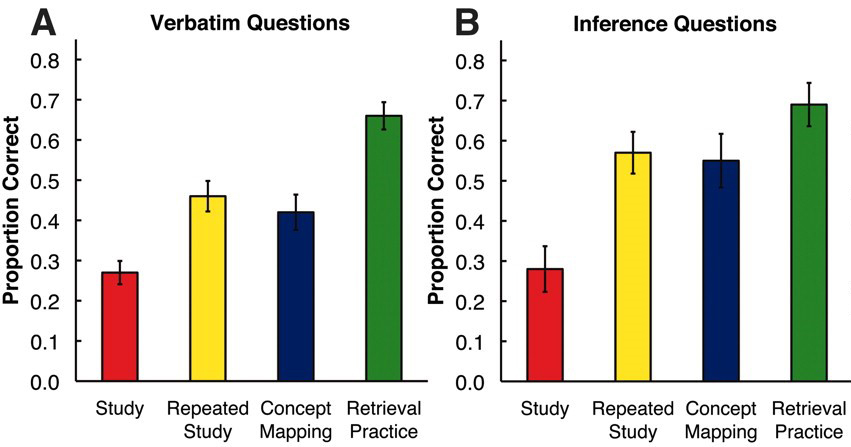
As you can see, the “Retrieval Practice” group (Group 4) was much better than the “Concept Mapping” group (Group 3), which was roughly comparable to Group 2, “Repeated Study.” Not surprisingly, Group 1 was the worst.
Maybe you expected group 3, the “Concept Mapping” group, to have done the best? At least I did when I first read about it.
It is interesting in itself that “Retrieval Practice” is most effective, but when we start looking at what the test subjects themselves rated as the most effective method, it becomes even more interesting.
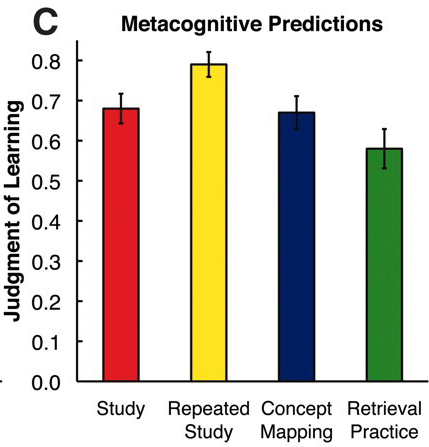
The participants believed that “Retrival Practice” was the least effective way to learn, when in fact the exact opposite was true.
Karpicke and Blunt expanded their experiment to investigate whether the effect and perception of the effect were the same for other types of content.
You can see the answer below.
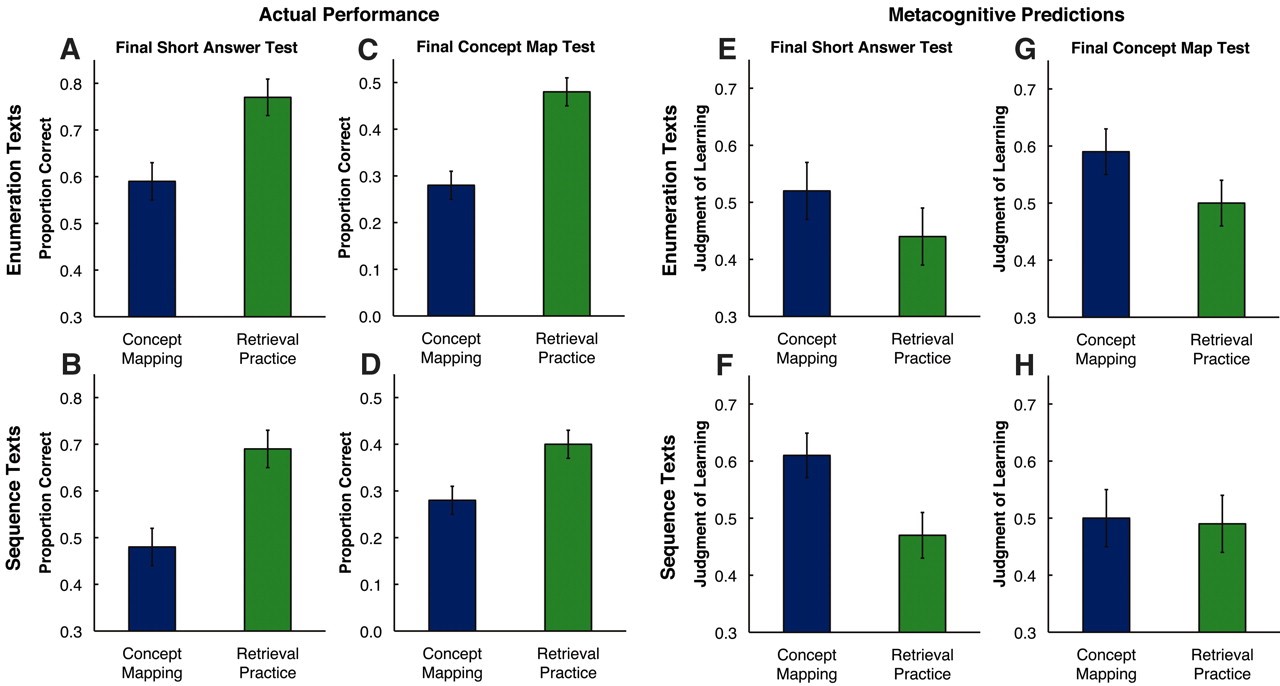
Blue bars show the “Concept Mapping” group, Green, the “Retrieval practice” group
Graphs A, B, C and D show the actual performance of the participants on four different types of tasks. In all cases, the “Retrieval Practice” group performs best.
Graphs E, F, G and H show the participants' expectations of how they would do. In all cases, the assessment is that the "Concept Mapping" group would do best. But it did not.
To summarize, “Retrieval Practice” is much more effective than “Concept Mapping” regardless of what needs to be learned, but the vast majority believe that it is the other way around.
Why is that?
A possible answer could be: self-overestimation and an innate urge to save energy.
Self-overestimation
There are many studies that show that we overestimate our own abilities [4] . One study examined how well Swedish and American people rated their driving skills. 93% of the American test participants and 69% of the Swedish test participants rated themselves as better than average. And that, by its very nature, cannot be true.
The cultural differences are of course interesting, but for now it is probably enough to note that both groups overestimated their abilities.
Studies also show that only one in 661 people say they are more affected by cognitive biases than average. [5] This phenomenon is called Bias blind spot.
When I first read about Karpicke and Blunt's experiment, I thought that "Concept Mapping" sounded like a nice visual way to work with the material, and that "Retrieval Practice" sounded pretty much like both stupid and hard work.
Since the brain doesn't like to work harder than necessary, it is "practical" for it to evaluate methods that don't require a lot of energy as being the most efficient. But this gives the illusion of learning.
It is reminiscent of the classic story of Euclid who replied to King Ptolemy II that “there is no royal road to learning geometry.” The king had asked Euclid if there was an easier way to learn geometry than reading Euclid’s book, “The Elements.”
Many people dream of a shortcut to learning, but there is typically a correlation between the mental energy used and how well one learns. It is very important to state that if you read this section as if I am advocating for rote learning in a big way, that is not my intention. You can read more about Karpicke's very interesting research here: https://www.apa.org/science/about/psa/2016/06/learning-memory
Karpicke and Blunt's study clearly shows that one must be very careful about basing one's assessments of what works in learning on one's own and others' subjective assessments, and that one should instead seek to make objectively verifiable measurements.
Do you want to? learn more?
If you want to know more about digital learning and e-learning, you can start with our E-learning FAQ
If you are interested in the brain and learning, you will probably like these articles.
- The brain and learning
- What happens in the brain when we learn?
- Brain function explained with Facebook
- Neuro for nerds: nerve cells, axons, dendrites and synapses
- Grandma neurons, Jennifer Aniston and Catwoman
- Neurons in an anesthetized cat
- This is your brain on Tetris
- The mental shotgun
If you are interested in reading more about motivation and learning, these articles may interest you.
- Self-determination theory. The most important theory you need to know about learning.
- Coercive design – how not to design e-learning .
- Which learning methods best support motivation for learning?
- Your brain is NOT a computer - Predictive Coding
- Flick 2 learn. Why Interactive elearning is NOT always exciting elearning
Are you looking for help with developing e-learning , or would you like a course on e-learning where you learn how to create e-learning yourself - we can also help you.