Your brain is NOT a computer - about Predictive Coding
Your brain is NOT a computer - about Predictive Coding

In everyday speech, we often describe the brain as a computer. For example, you might hear people say that they want to “save something on the hard drive” instead of saying that they want to remember something.
But the brain is NOT a computer and does not try to be one. At best, it would be a crystal ball that can see into the future.
Its main purpose is to be able to deal with situations that could arise in the future. Knowledge of the past, i.e. memories, is only important to the extent that it may help us make better decisions in the future.
Traffic hell in Sri Lanka
In 2014, I was on holiday in Sri Lanka with my wife and our two children. For 12 days we drove around the island in a rented car. We had also hired a local driver, Chanaka, to drive for us, as we didn't have the courage to drive ourselves in the very different and hectic traffic. The roads were bad, there were poor signage, people and animals were walking on the road, and no one obeyed the traffic rules. At one point I asked our driver how he managed to drive in that chaos. He replied that it wasn't chaos and that he could predict where obstacles would go. He said that both people and animals would probably move when a car came towards them. People always took the shortest route to get out of the danger zone, and cows never backed up. The only thing you had to be a little careful of were dogs. Dogs weren't really to be expected, but he didn't seem to be too worried about the thought of a dog coming around the bend from time to time. He wasn't special; they all drove more or less like that. Although we were sometimes heartbroken, no one got hurt during the time we drove with him, and we didn't see anyone else get hurt in traffic either.
In addition to the situations Chanaka could consciously formulate, I am sure that he also had an intuitive understanding to be able to predict a wide range of other situations that could arise in traffic.
Predictive coding
Imagine how Chanaka learned not to trust dogs in traffic? You can almost imagine it when he first saw a dog moving in a way that didn't fit his mental model.
Predictive coding theory states that in a given context we have an expectation of what will happen next, and that we continually update our expectation based on the sensory impressions we receive. Researchers talk about statistical learning because the brain builds its models of the world based on our previous experiences. If an infant has experienced that a pacifier always falls to the ground when it is thrown from a high chair, the infant's brain will develop a statistical model that says that pacifiers fall to the ground 100% of the time, and therefore it will be statistically unlikely that a pacifier will suddenly fall upwards.
If you experience that your prediction is not correct, what is called a prediction error occurs. The brain will then try to update its model of the world so that the prediction error no longer occurs. So learning is what happens when the brain corrects its understanding of the world to avoid a future prediction error.
This mechanism is supported by the fact that we are rewarded with dopamine in our reward system when we are able to predict events. We simply like to be able to “figure it out”, and we get bored if what happens is too predictable, because then we don’t learn anything. Conversely, we become uncomfortable if we experience too many prediction errors.
So our brain is simply coded to like to be met with appropriate challenges; not too easy and not too difficult.
The inverted U
Peter Vuust is a jazz musician and brain researcher, and head of the Center for Music in the Brain, which researches how music affects the brain. One of the most interesting things about the research Peter Vuust conducts and communicates is that it also helps you learn about how the brain works in general.
I attended a lecture with Peter Vuust, where he described an experiment that beautifully demonstrates how we react to prediction errors. In the experiment, different test subjects are exposed to different rhythms of increasing complexity, as illustrated below. (NB. The following illustrations do not show the actual experimental data, but simply visualize the principles).
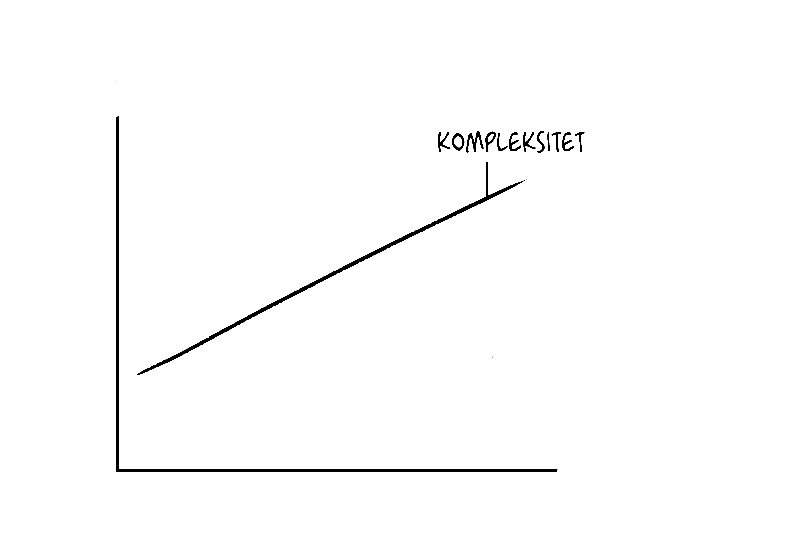
When listening to music, it is also about being able to build a mental model of what is going to happen. When listening to a rhythm, the mental model will typically enable you to predict what is happening in the rhythm and reproduce or “follow” the rhythm - if it is not too complex.
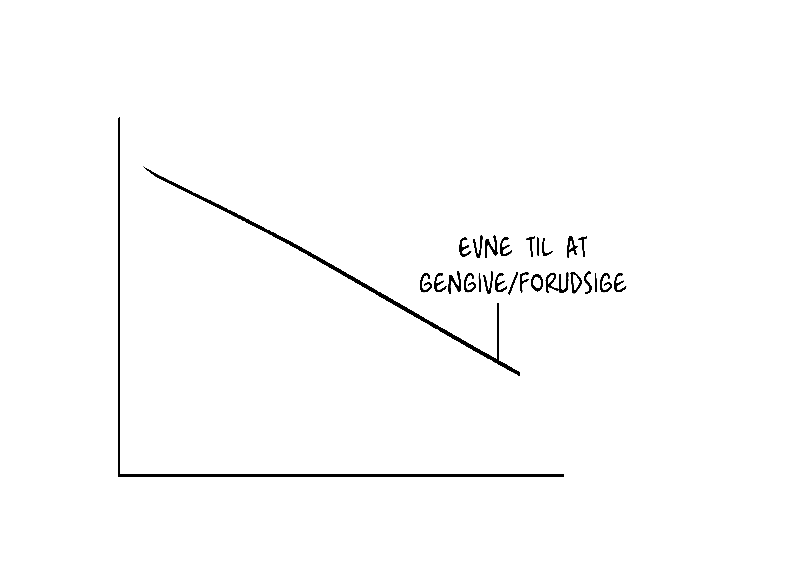
Not surprisingly, our ability to predict, and thus reproduce, rhythms declines as complexity increases and the number of prediction errors increases.
If you ask subjects what they like best, the graph shows an inverted U where the two graphs meet.
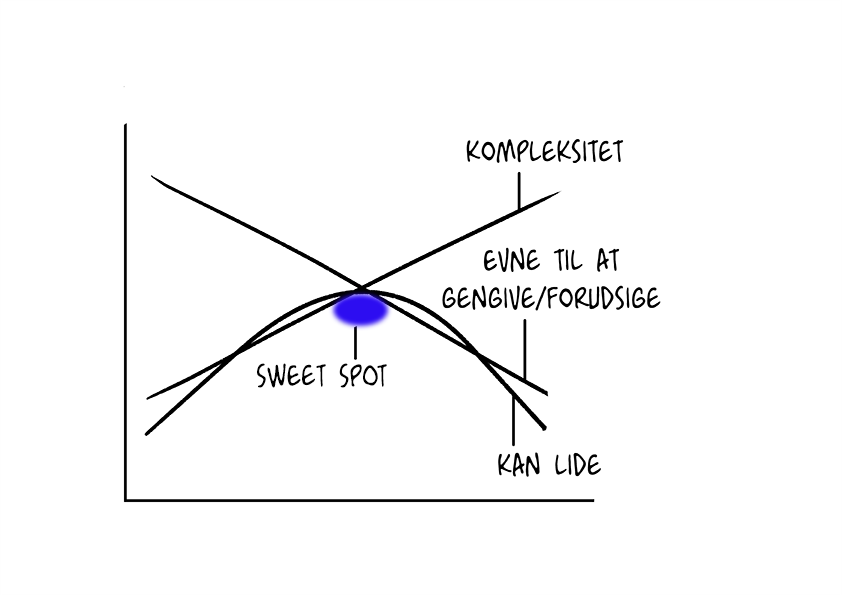
The area where we enjoy the task the most is called a 'sweet spot'. It is where the difficulty level is high enough, but not so high that we have too much difficulty predicting what will happen.
You can read more about music and the brain in Peter Vuust's highly recommended book "Music on the Brain".
Do you want to? learn more?
Maybe you could be interested in our Course in (digital) didactics - Learn to design good learning.
In this course you will learn how to develop learning that captures your recipients' attention and works with their motivation to learn. The course is also for those of you who teach in a classroom or online and need a professional boost.
Do you want to? learn more on your own?
If you are interested in reading more about motivation and learning, these articles may interest you.
- Self-determination theory. The most important theory you need to know about learning.
- Forced design – how not to design e-learning .
- Which learning methods best support motivation for learning?
- Flick 2 learn. Why Interactive elearning is NOT always exciting elearning
If you want to know more about digital learning and e-learning, you can start with our E-learning FAQ
Are you looking for help with developing e-learning , or would you like a course on e-learning where you learn how to create e-learning yourself - we can also help you.