

The structure of the brain
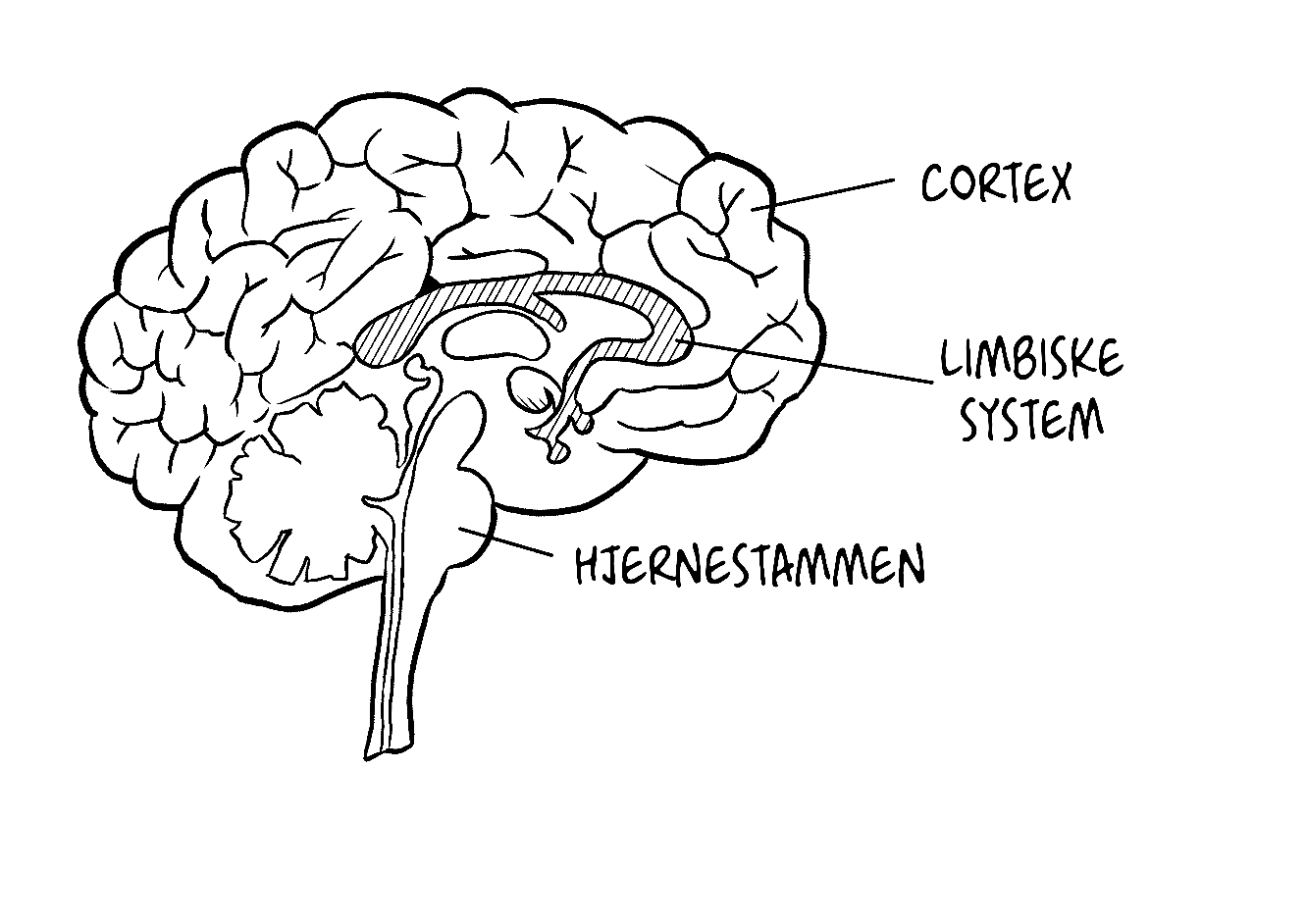
The brain can be divided into 3 “layers”. At the very bottom, and closest to the spine, we find the brainstem/spinal cord, which is responsible for the automatic functions of our body: our heartbeat, our breathing, etc. Outside the brainstem lies the limbic system. The limbic system handles, among other things, our emotions.
Outside the limbic system we find the cortex, which means 'bark' or 'crust' in Latin. The cortex is the layer that came last in evolution, and which we only share with other "higher" beings (monkeys, dogs, mice, etc., although it is not the same :-)). Humans are the creatures on earth that have the largest cortex in relation to the entire brain.
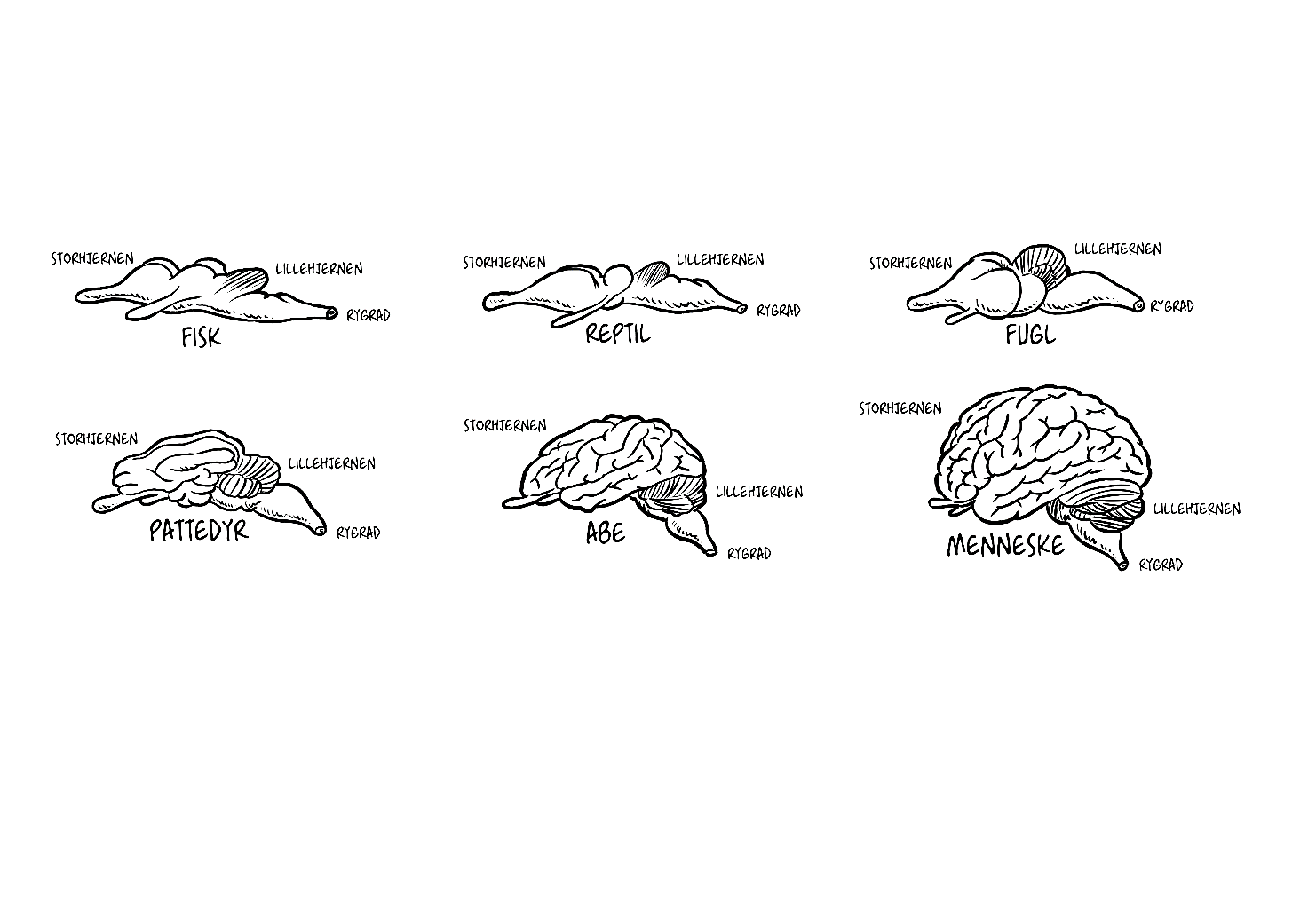
Here you can see the similarities between the brains of different organisms. Notice that the wrinkled surface, the cortex, is only found in mammals, monkeys and humans.
The cortex can be divided into two halves: the anterior (frontal) cortex and the posterior cortex. Roughly speaking, one can say that while the posterior half handles how we PERCEIVE the world (sight, hearing, etc.), the anterior half handles what we DO. For example, the sense of sight is located in the posterior area of the cortex, and what has to do with decisions and control of the body is handled by the frontal part of the cortex.
In the book Dr. Zukaroff's Testament, Peter Lund Madsen explains that the brain is constantly trying to answer two questions. Where am I? And what should I do? This matches very well with the two hemispheres of the brain. The back one, which interprets sensory input, thus answers the question "where am I?", and the front one, which makes decisions and moves our body, thus answers the question "what should I do?".
Now that we're talking about brain hemispheres, there's of course also the "classic" division of the right and left hemispheres. There is a visual cortex in both the right and left hemispheres. The right side takes care of visual impressions from the left eye, and the left side takes care of the right eye, and so the different functions are duplicated in both hemispheres - with certain variations. The right and left hemispheres are connected by a structure called the corpus callosum, which ensures that the two halves "talk together".
There are of course also structures in the brain for the other senses and for controlling our entire musculoskeletal system, but more on that later. Still other structures in the brain take care of a wide range of other functions that together give us humans the experience of being exactly us. For example, there is a center that is active when we find something disgusting (insula), a center that is active when we are angry and/or afraid (amygdala), a reward center (nucleus accumbens, etc.) - and many more.
You have to be careful not to understand the function of an area of the brain too squarely. It's a bit like asking which part of your body you use to stand on one leg? If you measure the activity level of all the muscles in your body, you would probably say that the thigh or foot on one leg is the most important, but at the same time we depend on many muscles throughout the body to keep our balance. And if we put the other foot down, we will no longer stand on one leg.
The brain is incredibly complex, and the outputs it produces are produced in an interaction between many different areas of the brain.
Nerve cells (aka neurons)
In the different areas of the brain, there are approximately 86 billion nerve cells, also called neurons. Nerve cells can make connections to other nerve cells. These connections allow the nerve cells to send signals to each other. The way they send signals is that they either send an electrical impulse or fail to send one. They can send many electrical impulses over time, but it is either or. When a nerve cell sends a signal, it is said to “fire” or ��be fired”.
New connections between nerve cells are formed when we learn something new, and these new connections allow our nerve cells to receive input from other nerve cells than they normally would. It is this additional input that allows learning to change our behavior and the way we perceive the world.
Where is broccoli stored in the brain?
It is important to understand that nerve cells in different areas of the brain have individual connections with nerve cells in other areas of the brain. For example, if we look at broccoli, most people will have nerve cells in the visual cortex that enable them to recognize broccoli. If you know that broccoli is called broccoli, there will also be connections to nerve cells in areas of your brain that enable you to say and hear the word broccoli. If you have tasted broccoli, there will also be connections to an area that handles taste. And there will be connections to areas that help you assess whether you like broccoli or not. So it is not that there is one broccoli area in the brain, but that broccoli is stored in several different areas of the brain, depending on which aspect of broccoli is in question.
Do you want to? learn more?
If you want to know more about digital learning and e-learning, you can start with our E-learning FAQ
If you are interested in the brain and learning, you will probably like these articles.
- What happens in the brain when we learn?
- Brain function explained with Facebook
- Neuro for nerds: nerve cells, axons, dendrites and synapses
- Grandma neurons, Jennifer Aniston and Catwoman
- Neurons in an anesthetized cat
- This is your brain on Tetris
- The mental shotgun
- Bias in assessing one's own learning
If you are interested in reading more about motivation and learning, these articles may interest you.
- Self-determination theory. The most important theory you need to know about learning.
- Coercive design – how not to design e-learning .
- Which learning methods best support motivation for learning?
- Your brain is NOT a computer - Predictive Coding
- Flick 2 learn. Why Interactive elearning is NOT always exciting elearning