

In this article I will:
- Explain what gamification is,
- Share some practical experiences with implementing gamification,
- Look at what science says about the effects of gamification,
- And finally, to make some recommendations on what to pay attention to if you are considering using game elements in connection with learning.
What is gamification?
Gamification is about bringing elements from the world of games into digital experiences that are not games. It is very popular within digital learning and e-learning because it is believed that it can make learning more fun and engaging.
Many people use the term Gamification to refer to all interactive e-learning that involves quizzes, tests and other interactive elements. But I think it is important to make a distinction here: We are big supporters of well-designed, targeted interactive digital learning that engages the recipients and makes them reflect and actively relate to the information they receive.
However, we are not enthusiastic about masking boring content with game elements to make it more appealing. Boring content does not suddenly become interesting just because it is wrapped in a game. Unfortunately, game elements that do not promote reflection and engagement do not contribute to learning.
We have written an article specifically about how to promote engagement in learning: The Key to Engagement: The Theory of System 1 and System 2. Here you will also get an explanation of the difference between motivation and engagement.
With that understanding in place, let's dive into Gamification.
What elements from games are used in gamification?
If you read about gamification, you will find different opinions on which elements are game elements. Here is a non-exhaustive list:
- Progression . Something that shows progress. levels, boss levels, or things that the player receives in the game - which give an advantage in the game, for example better equipment.
- Rewards : Typically points, badges, highscore lists.
- Storytelling / Narrative . That the game is wrapped in a story or has “quests” that must be completed.
- User choice . That the user can choose and that the choices have consequences.
- Rules . That the game has a rule system that applies. For example, whether you can die in the game, or how many times you have to shoot a monster to kill it.
- Time . That there is a time limit that counts down or something like that.
- Social elements : Cooperation or competition with other players.
- Personalization . For example, the ability to design your own game character.
- And then what you can call the user ( game) experience . Micro-interactions supported by sound and animation, for example when you have to click on a crop to harvest it. Or when points or money “flow in” rather than just being added to the existing sum.
If you have played computer games yourself, whether it is Angry Birds, Counter Strike or Civilization, then you know that it is very important how the individual elements are implemented and play together. For example, it is not enough that there is a story. The story must also be good . (And how to write a good story is a whole chapter in itself). It is also not enough that there are choices in the game. If the choices do not influence the course of the game, it is not experienced as a real choice. It is therefore often quite complex to make a good/fun game.
Among the most frequently used game elements is that you are rewarded with points, badges or stars for solving some tasks. Often a social or competitive element is also included, preferably in the form of a highscore list, where you can see how you compare to other users. This is so common in gamification that it has been given an abbreviation: PBL (Points, Badges and Leaderboards).
Research has shown that we humans quickly start to expect the rewards we are offered and therefore do not value them. This mechanism is called the overjustification effect, which you can read more about here . To counter the overjustification effect, many designers in gamification (and games) seek to give users unexpected rewards, but in the end, they actually start to expect them.
Many have probably experienced gamification systems that almost become patronizing due to excessive use of PBL. Personally, I quickly get a little tired when I get an unexpected badge for accidentally shooting a bird backwards in Angry Birds, or if I register as a user in a “gamified” Learning Management System and get the message: “CONGRATULATIONS (first name), You got a badge because you are so cool that you registered…”
Gamification looks very promising on the surface, but when you delve a little deeper into the individual elements and their actual effect, the picture becomes more mixed. The overjustification effect is always lurking, and one can rightly ask whether users could ever be entertained by a gamified presentation of a company's HR policy or fire safety routines.
Practical experiences with gamification
Together with a friend, I once created a gamification app/platform for retail staff. The concept was that employees would receive a daily SMS with a task to complete during their workday. The goal of the task was typically to learn how to sell more.
In retail, there is a concept called the neutral greeting. The idea is that if you walk into a store and the staff asks, “Can I help you with something?” most people will say, “No.” Most sales training will tell you that it’s a bad start if a potential customer starts by saying no. That’s why many people who work in retail learn to use neutral greetings, such as “hello,” which are neutral greetings that don’t result in a yes/no answer. Studies show that stores can significantly increase their sales if the staff simply switch from “Can I help you with something?” to neutral greetings.
A task in our app could therefore be: Come up with three different neutral greetings and use them on customers today. Share your experiences with your colleagues in the field below. Another could be: Suggest a scarf to everyone who tries on a jacket. The idea was that users were challenged to do their work in a way that could also increase sales in the store.
If you want to use fancy buzzwords, you could call it situated learning, presented as mobile gamified micro learning. But in plain English, we simply used a smartphone to get some people to learn something while they were at work - by giving them small tasks every day.
At first, we focused a lot on giving points, etc., but later we focused more on the social aspect, where employees collaborated via our app. This shift was primarily due to us becoming wiser and seeing that our focus on PBL had a negative effect on some of the participants' engagement. There were several things that pointed in that direction, but one anecdote in particular from a round of user feedback says a lot about how the points system was experienced by the staff. We had sold our solution to a chain of retail stores and had just completed a program with tasks for the staff. We subsequently asked them for their feedback. An older employee, who was one of the store's most experienced salespeople, had done our tasks, and had otherwise focused on taking care of her job of selling. When she looked at the high score list in our app after a week and saw that the young, newly hired employee was higher than her on the high score list, she was very disappointed. She had focused on doing her job, but the young new employee had been better at solving the tasks in the app, and had therefore achieved a better score. In our attempt to motivate employees, we ended up rewarding those who focused on the tasks and disappointing those who focused on doing their job.
What does the research say? Does gamification work?
When gamification is used as much as it is, is its effect solidly supported by scientific research? The short answer is: “No.”
If I google: Does gamification work, I quickly find two scientific articles that both review the existing research in the field.
- " Does Gamification Work? -- A Literature Review of Empirical Studies on Gamification " from 2014 by Juho Hamari; Jonna Koivisto and Harri Sarsa.
- " Does gamification increase engagement with online programs? A systematic review " from 2017 by Looyestyn, Kernot, Boshoff, Ryan, Edney, Maher.
I also find a lot of blog articles - many from people who clearly make a living selling gamification. They may be right anyway, but here I will allow myself to be skeptical and give more weight to scientific articles.
I will spare you a detailed review of the mentioned articles - which I of course think you should read yourself - and give you my brief conclusion here:
The answer is:
No, gamification is not solidly supported by scientific research.
The slightly longer answer is that there are actually studies on the effect of gamification, but that they are of very variable quality, and that they do not provide a clear answer as to whether gamification works, and if so, which game elements make it work.
Some studies report both positive and negative effects, and the trials are also criticized for being short, which makes it difficult to rule out that the gamified is simply experienced as exciting because it is new.
The effectiveness of using game elements depends entirely on how it is implemented and in what context it is used. A major problem with the available research is that the different studies use different definitions of what Gamification actually is. Therefore, the answer to “Does gamification work?” cannot be a simple yes or no.
In short, it is neither well-researched nor well-substantiated that gamification unambiguously increases user engagement in what is presented.
Does gamification have an effect?
Here the answer is unequivocal: “Yes!”
But it is unclear what the effect is and how the different game elements affect user engagement.
The studies that are most positive about the effects of Gamification often use a definition of Gamification that goes beyond the use of points, badges, and highscore lists (PBL), and especially uses social elements, choices, and storytelling. However, it is most often the simple PBL version of Gamification that is offered and demanded.
The above articles conclude that gamification appears to have a positive effect in the short term, with clear results in terms of engagement if participants only complete the activities once. However, the results become more mixed in studies that look at gamification over a longer period of time - the positive effects of gamification appear to decline over time. The very same elements that some respondents reported as engaging and fun were identified as negative by other respondents.
Doesn't it matter that the science is unclear about the effects of gamification?
Yes, if it were harmless and free to use gamification. But it is not. Maybe it increases engagement, maybe it harms. No one knows for sure. If it is ineffective, it is at best a waste of resources that could, for example, be used to create better content. In the articles you can also read that it can have negative effects on engagement if you suddenly remove gamification elements once you have introduced them. Therefore, you should think twice before blindly following the herd into gamification land.
Which elements have the least potential to work?
By far the most common way to introduce gamification to learning is by introducing systems that revolve around what we previously described as PBL - Points, Badges and Leaderboards. But when digital points become an end in themselves, it has consequences for the students' learning - the novelty value of the systems may drive a little engagement, but in the long run it removes focus from the elements that are most important to the student. Margaret Robertson has coined the term pointsification , which describes "taking the elements that are least important in games and making them the core of the whole experience".
Which game elements have the greatest potential to work?
The answer, unfortunately, is that all of the best game elements are also typically the most complicated and extensive to develop:
- Good storytelling. There's a huge difference between an interesting story that's meaningfully woven into the educational content, and a boring story that could have been tacked onto the educational content at the last minute. If you can do the former, you'll have a good starting point for keeping users' attention.
- Social elements. If implemented correctly, social elements can act as a strong motivational factor for users. Here it is again important to emphasize that the social elements must actually have a meaningful impact on the system as a whole; featureless friend lists or a high score list can often be worse than nothing.
- Meaningful choices. Real and fun games are about meaningful choices. In most gamification, users' choices have little influence on what happens in the game itself, often resulting in the user feeling limited and restricted.
Meaningful choices have the potential to motivate the user by offering an experience of exploration and autonomy.
A general piece of advice for implementing any game element is that it should interact with the content and with the other game elements. Here we can talk about a kind of synergy effect between elements that together form a whole that is greater than the parts:
For example, an element like competition, as mentioned, does not work very well.
But if a social element is introduced that makes the player work together with other players in a group and compete against other groups, then the competitive element works better.
Bing Gordon, a former board member of Zynga (the company behind the Facebook game Farmville), is a strong believer in collaborative social elements: He says that “collaboration beats competition three to one.” That is, collaboration creates significantly more engagement than competition does. Zynga has around 21 million daily users, which means they have a lot of data to back up what they say.
Conclusion: Is it a good idea to use gamification?
I believe that you have to be very careful when using game elements for learning. I have some experience with gamification, and I know that it can have definite negative effects if game elements are used incorrectly.
There is a very telling term that describes botched implementations of Gamification: mandatory fun.
That doesn't sound very fun, does it?
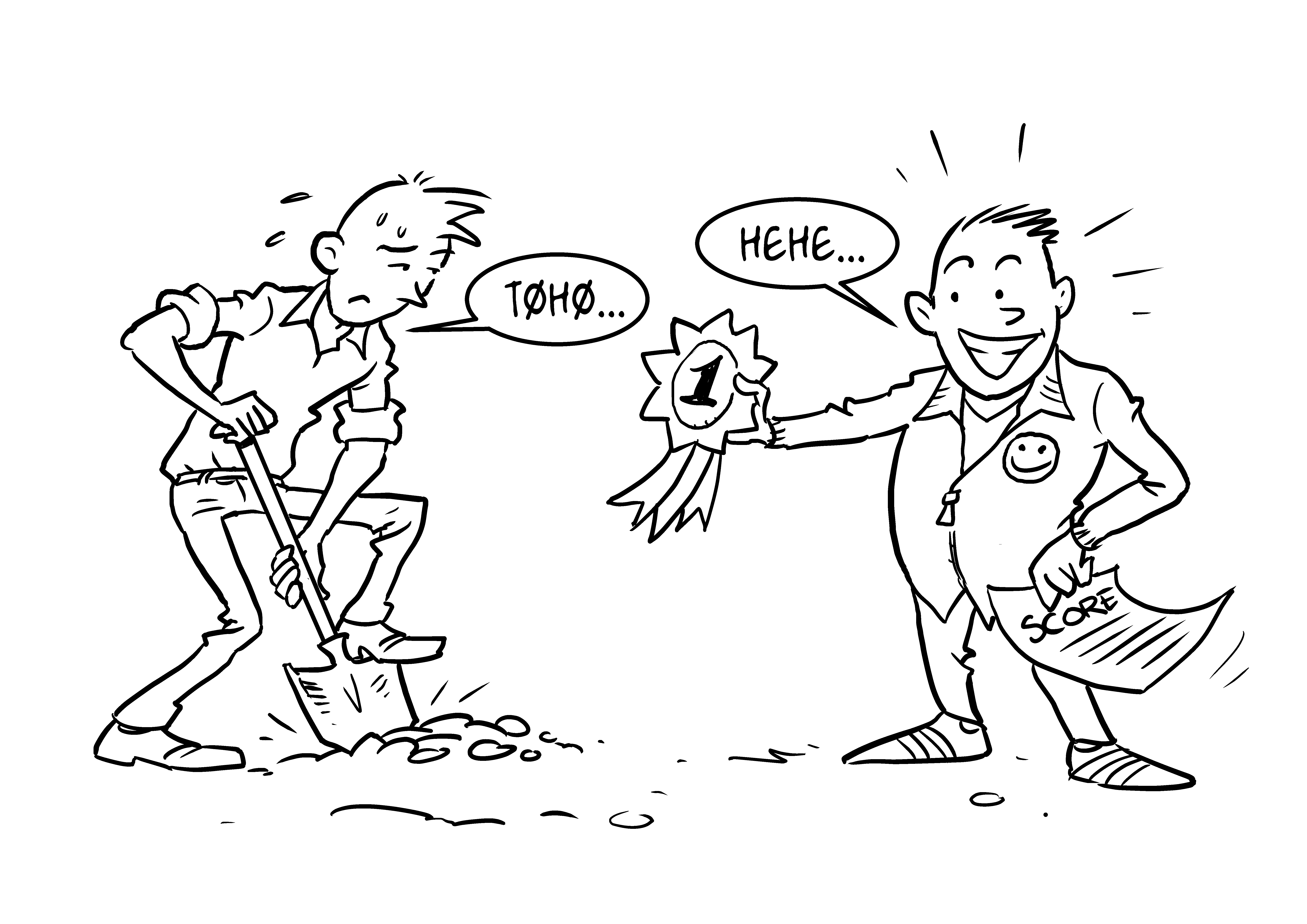
In connection with my work designing digital learning and e-learning, I often receive inquiries from clients who want to make some boring and mandatory content exciting by using gamification. For example, it could be a quiz you have made about Nem-ID and Nem-Konto, you want to make it fun by wrapping it in a game and creating a highscore list. This solution is often chosen because it is easy (read cheapest) to implement.
My somewhat boring answer to them is that we can help them make the content more exciting, but the bottom line is this:
Boring content doesn't become exciting by being disguised as a game. But exciting content wrapped in a game can be exciting.
You shouldn't think that just because something uses gamification, it's automatically good.
I love using game elements when developing learning materials, whether it's digital learning or the analog kind, and I strongly believe in play and games in connection with learning, but there's far too much bad gamification out there. Bad gamification promises a quick fix, but is often nothing more than pointsification and mandatory fun.
If you want to use game elements to increase user motivation, the main focus should be on good content and on using the game elements intelligently and in a nuanced way. One could appropriately take as a starting point the game elements that align with the Self-Determination Theory, which I have written about here . (The Self-Determination Theory is about motivation and is probably the scientific theory that is most relevant to know in relation to gamification.)
Gamification should treat participants like real people instead of promising virtual points to get participants to run around in a digital hamster wheel.
I 'd love to hear from you . Maybe you know of some good research I should know about, or you have an example of good or bad gamification. Of course, you're also welcome to contact me if you'd like some good advice on implementing gamification, I love tinkering with game elements and motivation!
Do you want to? learn more?
Maybe you could be interested in our Course in (digital) didactics - Learn to design good learning.
In this course you will learn how to develop learning that captures your recipients' attention and works with their motivation to learn. The course is also for those of you who teach in a classroom or online and need a professional boost.
Learn more on your own
If you are interested in reading more about the brain and learning, these articles might interest you.