

Armed with knowledge from our Facebook example , let's look at the biology.
A nerve cell functions by means of electrical impulses and typically fires between 5 and 50 times per second. Each individual nerve cell can make thousands of connections to other nerve cells using extensions called axons and dendrites.
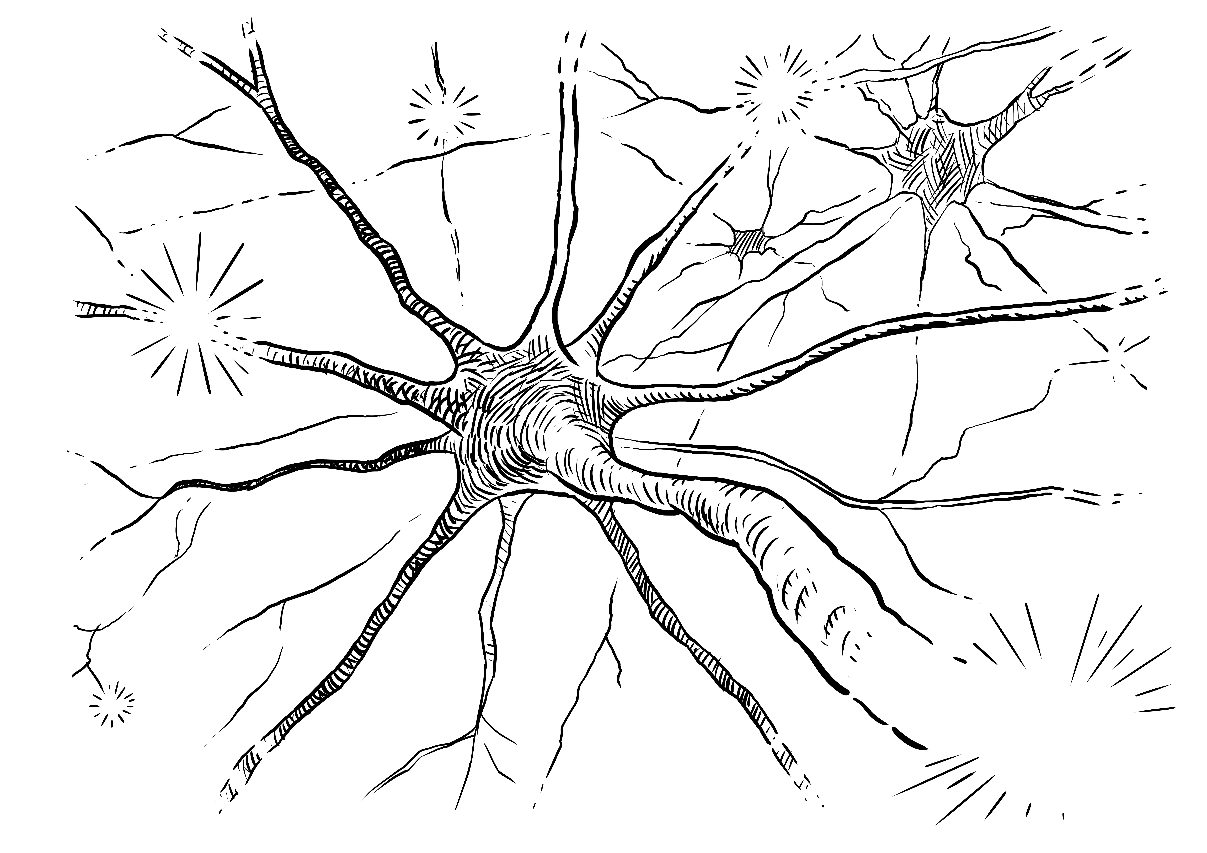
Dendrites from one nerve cell connect to an axon on another nerve cell. However, the axon and dendrite do not touch each other, as there is a small gap of about 20 nanometers between them. This gap is called a synapse.
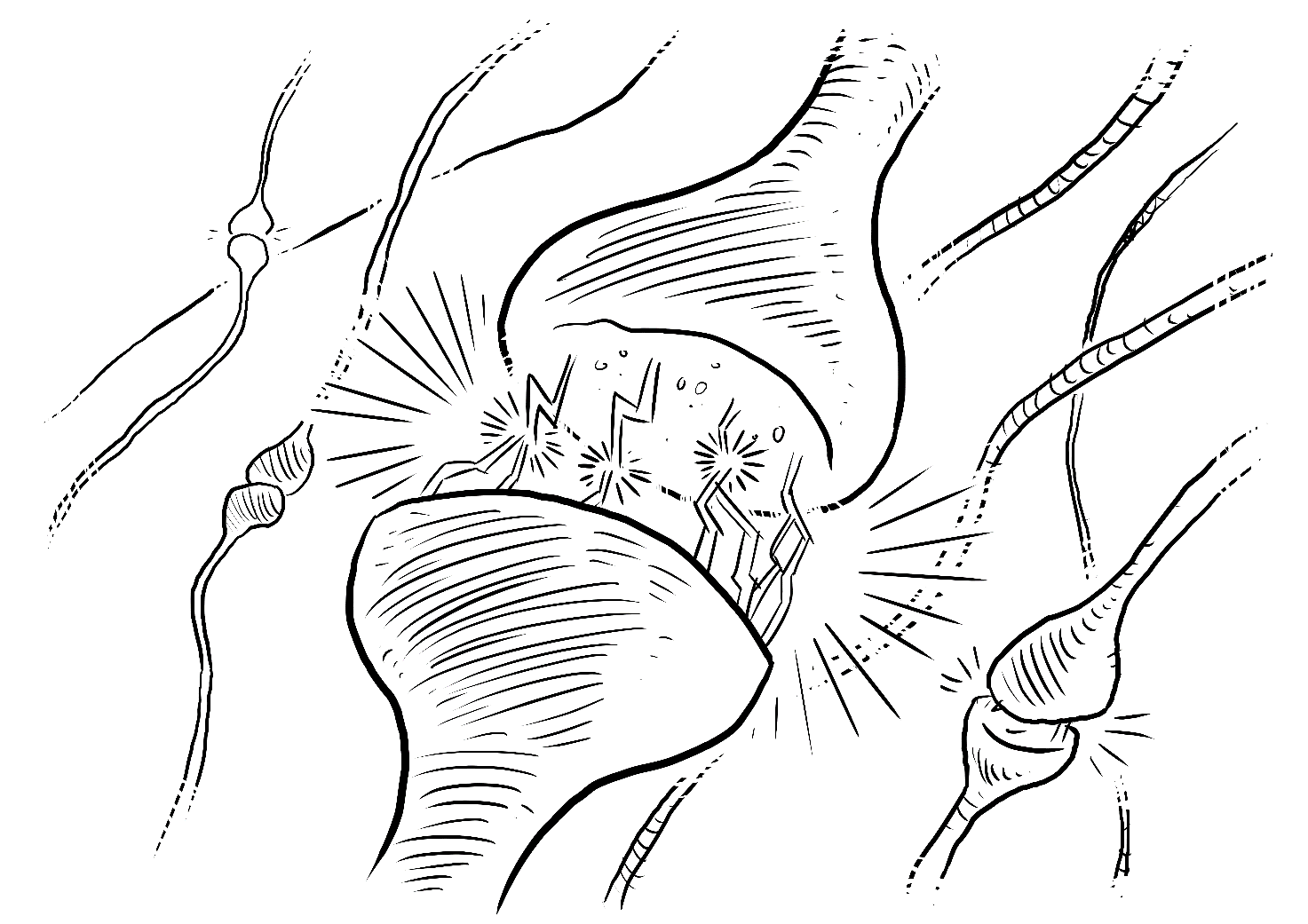
When a nerve cell fires, it does so by sending electrical impulses from the nucleus of the nerve cell out into the dendrites. When the electrical signal hits the end of a dendrite, the impulse causes small containers in the dendrite, called vesicles, to open.
Neurotransmitters
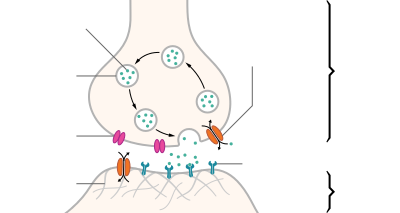
The vesicles are filled with neurotransmitters that flow out into the synaptic cleft. When the neurotransmitters hit an axon on the receiving nerve cell, the neurotransmitter opens a “gate” on the axon of the receiving nerve cell, allowing the signal to pass on (again as an electrical signal). The signal travels to the nucleus of the receiving nerve cell, where it “waits” for the electrical energy to be high enough for the nerve cell to fire and transmit the energy.
You may have heard of neurotransmitters before? Here are some of the most well-known: adrenaline, dopamine, melatonin, serotonin, endorphin and oxytocin.
Different nerve cells use different neurotransmitters in their synapses. What “counts” is whether the nerve cell fires, not which neurotransmitters are used in the process.
When do nerve cells fire?
When a signal jumps from one nerve cell to another, the “signal energy” in the receiving nerve cell increases. A nerve cell can be connected to many other nerve cells, which can also fire if there are enough synapses that deliver energy (Facebook likes) to “our nerve cell”. When the voltage eventually reaches a certain threshold, the nerve cell will fire, sending the energy on to other nerve cells via the synapses that it is now connected to. If the voltage in the receiving nerve cells reaches above the threshold, the signal is sent on to the nerve cells that it is connected to, etc. etc. In the nerve cells where the threshold is not reached, the signal dies out after some time.
This means that a nerve cell can be fired both due to many weak signals and due to a few strong ones.
It is important to understand that a nerve cell either fires or does not fire. 'Strong' signals mean that the threshold is reached many times in a short time in a nerve cell, and that it therefore fires many times, thus sending many impulses to the nerve cells it is connected to.
For example, if there was one nerve cell that made you cry, the tears could flow either as a result of strong signals from a few connected nerve cells, or as a consequence of many nerve cells with lower activity. This is of course a simplified explanation, but hopefully it has given you an idea of how nerve cells “talk to each other”.
Associations and manipulations
The fact that the brain favors connections that are already strong is absolutely central, and shows itself in a wide variety of ways in the way we behave and think. If you want to test this mechanism on yourself, try doing the following: Start by thinking of a word, e.g. summer vacation. Now think 'beach, sun, palm trees' and continue associating. (You can also start with Christmas tree, gifts, Santa Claus, etc.)
Once you've done that, try to think of different words that have nothing to do with each other, such as spaceship, cucumber, mother, etc. Typically, the last exercise will be more mentally demanding – at least until you figure out how to 'set the autopilot' on the task.
It's actually the same mechanism we try to exploit when we try to remember something we've forgotten. We try to recall things, places or stories that can make us associate ourselves with what we're trying to remember.
Another consequence of this is that we are easily influenced by our surroundings. What you see with your eyes, hear with your ears, etc. automatically starts to influence you, where your chains of associations are based on what you sense. It is smart that we relate to the reality we are in, so it is not a "mistake", but a condition of the way we humans are.
But it is also a condition that means that it is relatively easy to manipulate us humans by exposing us to stimuli.
For example, try not to think about a red ball right now.
Try not to finish the line: erle perle pif paf puf, away with the dirty…
Difficult, isn't it? (At least I can't help but "fall in").
The fact that we humans are easier to influence than we think is an area that is very close to my heart. I am particularly interested in how we can dress people up so that they are harder to manipulate. This is especially important in an era when companies hire behavioral psychologists to help them influence us to use their products. Defenses against this kind of neuro-manipulation and knowledge about how the brain works should be a standard curriculum in all education, if you ask me.
As you might guess, this is a topic I'll return to, but for now, let's wrap up by summarizing that the brain favors connections that are already strong , and that this has some pretty far-reaching consequences for how we behave.
Do you want to? learn more?
If you want to know more about digital learning and e-learning, you can start with our E-learning FAQ
If you are interested in the brain and learning, you will probably like these articles.
- The brain and learning
- What happens in the brain when we learn?
- Brain function explained with Facebook
- Grandma neurons, Jennifer Aniston and Catwoman
- Neurons in an anesthetized cat
- This is your brain on Tetris
- The mental shotgun
- Bias in assessing one's own learning
If you are interested in reading more about motivation and learning, these articles may interest you.
- Self-determination theory. The most important theory you need to know about learning.
- Coercive design – how not to design e-learning .
- Which learning methods best support motivation for learning?
- Your brain is NOT a computer - Predictive Coding
- Flick 2 learn. Why Interactive elearning is NOT always exciting elearning