
There are many things we experience in the course of a day that the brain does not attach any particular value to, and therefore we cannot remember them. Imagine sitting at the checkout in a supermarket for a whole day. You certainly cannot remember all the individual items you scanned, or the customers you served for that matter. You typically remember the ones that have been a hassle, both items and customers. For example, I know that the staff at my local SuperBrugs are incredibly good at remembering item numbers on items that do not have barcodes.
Muller conducted an experiment in 2008 where he compared the learning outcomes of two different videos. One group of students watched a clear video with good, clear explanations of some physics theories. The other group instead started by watching a video in which two people discussed common misconceptions regarding these physics theories.
Next, both groups received the same explanation of these physics theories. Although Group 2 rated their overall instruction as being more difficult to understand than Group 1 did, they were able to remember the theories better than Group 1 could. This concept is called cognitive friction. Psychologist Daniel Kahnemann also touches on cognitive friction, and in his book “Thinking – Fast and Slow” refers to an experiment in which researchers asked 40 Princeton students to take a test called CRT (Shane Frederick’s Cognitive Reflection Test). Half of the students saw the test written in small font on poor print. The test was readable, but difficult to read. The other half received a normal readable test. The result was that 90% of the students who took the “easy” test made at least one error on the test. Only 35% made errors on the difficult test.
Daniel Kahnemann suggests that this could be because students on the difficult test need to activate the areas of the brain responsible for conscious thinking, which Kahneman calls system 2, in order to understand the test at all, and thus "think better".
It seems that things that have been difficult to perceive are also difficult to forget. As if we remember things better if we have had to work for it.
The research behind cognitive friction underlies the development of a new font called Sans Forgetica.
Here you can see an example of it: 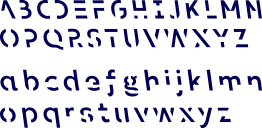
You can read more about, and also download, the font here: https://www.1001fonts.com/sans-forgetica-font.html .
But you shouldn't overdo the use of cognitive friction, right? Cognitive overload is very close.
V1 M3NN3SK3R LÆR3R B3DS7 N4R V1 GETS 10V 7il S3LV 47 “R3GN3 D3N UD”
By using cognitive friction, I have constructed this little mnemonic: “V1 M3NN3SK3R LÆR3R B3DS7 N4R V1 GETS 10V 7il S3LV 47 “R3GN3 D3N UD”.
This will sound obvious to most people, but I still have to take some time to say it: People don't learn anything by having it repeated endlessly. You can't "fill learning onto" a person like you fill a car with gas. The term "gas station pedagogy" describes this thinking.
When I feel the need to mention it, it is because you hear many myths to the effect that
- You have to hear something 1000 times before you learn it.
- If you do something for 10,000 hours, you become an expert at it.
That doesn't fit.
People learn when they are given the opportunity – and have the motivation – to figure things out for themselves. And they get better at it if they practice it and get feedback when they make mistakes, or can otherwise optimize what they do. The feedback should indicate how to improve what you are doing wrong.
One of the problems with the above myths is that they are simply too square and unvarnished. If you live next to a railway, you learn to ignore the sound of it. (Hopefully before you've heard it 1000 times).
If you hear a statement that you disagree with 1000 times, it doesn't mean you start doing what you're told. Doing something for 10,000 hours doesn't necessarily make you an expert if you don't get feedback on what you're doing. For example, I've probably driven a car for more than 10,000 hours, but that doesn't make me anything more than an average driver. It's clear that there's a correlation between your experience and how good you are, but you don't automatically keep getting better at something that you do/hear/see many times.
Do you want to? learn more?
If you are interested in reading more about the brain and learning, these articles might interest you.
- Flick 2 learn. Why Interactive elearning is NOT always exciting elearning
- This is your brain on Tetris
- The mental shotgun
If you want to know more about digital learning and e-learning, you can start with our E-learning FAQ
.... and are you looking for help developing e-learning , or would you like a course on e-learning where you learn how to create e-learning yourself - then give us a shout.