
Compliance learning without the learning theatre
Mandatory courses on GDPR, information security and health and safety, built around the few things people need to do differently. And an honest answer when a course is not what is needed.
»It has been great to collaborate, where our ideas and wishes have been challenged in a good way.«
What makes compliance hard
Compliance is where e-learning most often ends up as theatre. People are put through a course, not because the behaviour needs to change, but because someone has to be able to document that everyone has been through it. Afterwards there is a green tick in the tracking system, and out in the working day everything is as it always was. Nothing has changed.
One of the hardest things about compliance training is that you have to teach people something they already think they know. Or something they may well find important – but also a little boring.
The reaction from the sender is usually to make it more interactive, or to add nicer animation. To put a director at the start who can say that it matters. But if you do not actually solve the problem, you have ended up in learning theatre: something that looks like learning – neat slides, a talking head, a quiz everyone can pass – but which creates neither learning, behaviour nor value.
»I do not need a course on IT security. I need to be less busy.«
Lars, IT architect (an expert in IT security), quoted in the book Superlæring 2 — Fra læringsteater til adfærd (forthcoming).
The harder you try, in the wrong way, the worse you risk making it. A set of rules becomes comprehensive by growing, and the more that goes in, the less of it sticks. Go for perfect compliance, and you end up with less compliance.
The irony is that much compliance training forgets to communicate in a way people respond to, while saying that the biggest cause of error is people. It rests on a false inference: information does not necessarily produce learning, and learning does not necessarily produce behaviour.
Turn the course around, and start with the situation
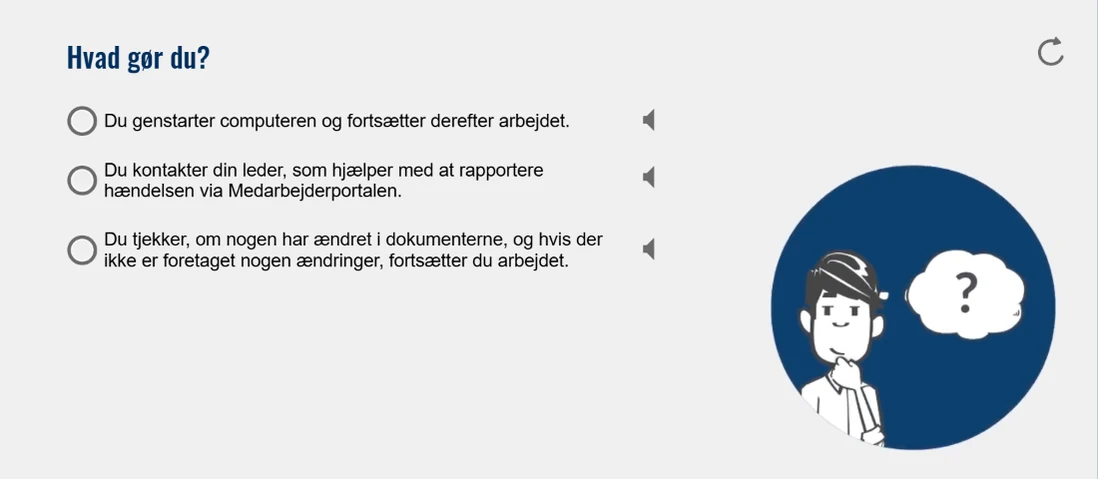
Instead of dumping the theory on people and finishing with a test, translate the theory into situations your audience actually runs into, and ask them to act.
Do not give them the theory first. Throw them into it and let them choose what to do. If they answer wrongly, you can give them the theory as feedback. If they answer correctly, they get through the course faster.
The questions have to be hard to answer. Can they recognise a data breach? Do they know how to report it? Can they spot a phishing email?
Sometimes it should not be a course at all
Some of what is a compliance course today works better as something else. A checklist. A diagram of who to ask and when. A message that arrives at the right time in the right place in the system.
Competition Compass
In doubt in a conversation? Answer yes or no.
Is the other party a competitor? YES
- YESIs it about prices, plans, capacity or customers? STOPSay no out loud · Leave · Tell Legal today
- YESOnly public or general information? GOStick to the facts · Topic changes? Start again
- NOOnly public or general information? PAUSENo agreement, no figures · Ask Legal first
Is the other party a competitor? NO
- YESAbout their resale price — or a competitor's information? STOPSay no out loud · Leave · Tell Legal today
- YESExclusivity, sales limits — or are we big in the market? PAUSENo agreement, no figures · Ask Legal first
- NOExclusivity, sales limits — or are we big in the market? GOStick to the facts · Topic changes? Start again
Authorities at the door? Cooperate · Call Legal · Delete nothing. If in doubt, choose PAUSE. Training aid, not legal advice — Legal/Compliance decides. Simplified draft of the Competition Compass.
The test is the same every time: does this make it easier to act correctly — or harder to act wrongly? If the answer is not obvious, it should be cut.
Our compliance solutions therefore tend to be shorter and more targeted. They often consist of a shorter course or a video, supported by other solutions.
An example
Esbjerg Municipality asked us to adapt a one-and-a-half-hour course for managers on sickness absence from another municipality. We suggested something else, and they were up for it. First a workshop with managers, union representatives and health and safety people about what stood in the way of the municipality’s own 1-5-14 model.
The workshop showed that it was not a lack of knowledge, but rather that managers and employees could not see the point, and perhaps were not entirely comfortable following the rules either. The solution was, among other things, to address both through three short explainers running nine minutes in total. At the heart of it was the video that established a mutual expectation that the manager would call on day one.
How we have done it before
Odense Municipality
Information security, GDPR, good administrative practice and health and safety for a municipality where roles and starting points vary widely. It became five modules running just under an hour and a half in total, built together with the municipality’s own specialists: a basic module on handling data and information well, for people who do not work with these subjects day to day, and four that go deeper.

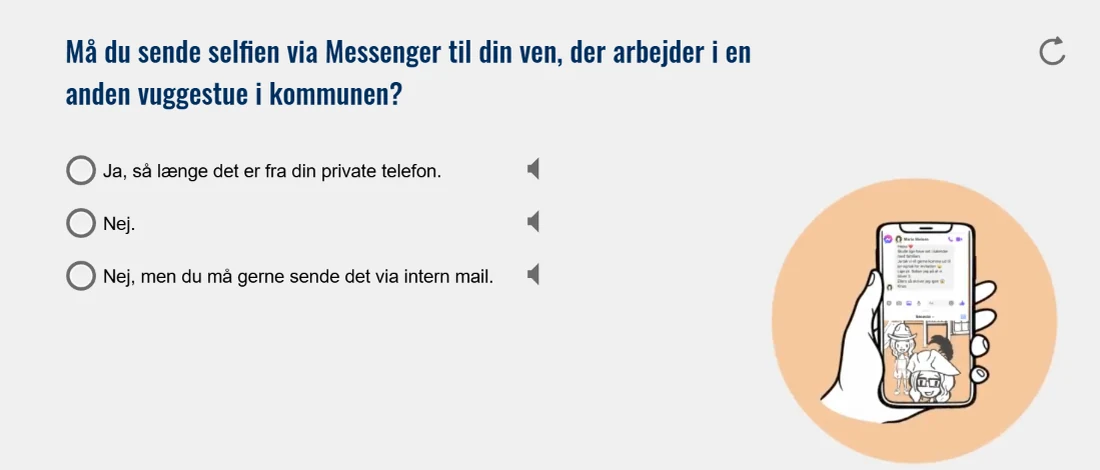
From two of the five modules: the basic module on handling data well, and the GDPR module.
Aarsleff Rail
A mandatory safety course for both their own employees and external partners, which has to be completed before you get access to the site. The course takes about seven minutes and comes in Danish, English, German and Polish in the same package.
The whole course is situations from a real workplace. You have to fetch materials some distance away, and between you and the materials lies the track. What do you do? The course is partly about hazard blindness: when you have done the same thing many times without incident, it starts to feel less dangerous, even though the risk is the same.

»It has been important to us to develop a safety course that works in the reality our employees and partners face every day. Safety is not only about knowing the rules – it is about being able to make the right choices in concrete situations. That is why we have focused on making the learning simple, accessible and close to practice, with realistic cases, mobile access and a format that is easy to complete out on the site.«
Your own system, your own languages
We deliver e-learning in SCORM 1.2 or 2004, and the package sends both completion and the results of the questions back to your own system. If you do not have a system for tracking and reporting, you can use our Activate LMS.
We can build courses in any language you need. We have made e-learning in Greenlandic, Ukrainian, Polish, German, English and Swedish, among others.
Accessibility follows WCAG 2.1: subtitles, keyboard navigation, contrast and alternative text.
How it works
- WorkshopWe start with you, with the people who own the rules, and preferably a couple of the people who have to follow them. What is it people need to do differently, and what stands in the way — is it unsafe to speak up, does the rule not make sense where you stand, can people not do it, or is it simply too much trouble? The answer decides what gets built, and whether part of it should not be a course at all.
- StoryboardYou see the whole course in writing, situation by situation, before anything is produced. Your lawyer or compliance officer reads it through and makes corrections while corrections are still cheap.
- ProductionSituations, answers, feedback, animation and voice-over are built on the approved storyboard. Translation and recording come in here.
- DeliverySCORM package, source files and rights. We help you put it in place and check that completion and results come back the way they should.
What it costs
Most compliance projects land between DKK 30,000 and 120,000 and are ready in four to twelve weeks. It depends on how many subjects go in, how many situations have to be built, and how many languages it goes out in. Large programmes with many modules and languages go up to DKK 250,000.
If you need a version of something that already exists, the adaptation costs less, because the script and the animation have been made.
Frequently asked questions
We need to document that everyone has been through it. Can we?
Yes. Completion, time and answers are sent back to your own system, as in any other SCORM course. The difference is what it takes to pass: situations you have to handle, instead of definitions you have to recognise.
Can we edit it ourselves afterwards?
Yes. It depends a little on the solution. If we record a video it is of course harder, but if you want to edit a few questions in a quiz, that is no problem.
We already have a course. Will you look at it?
Yes. Send us what you have, and we will tell you what we would do differently. Sometimes the answer is to cut something out rather than build something new.
Send us your rules
The policy, the guidance or the course you use today. We will come back to you with what needs to be practised, what can be handled with a checklist, and what can be cut.
Tomas Pødenphant Lund, ElearningSpecialist
Write: info@elearningspecialist.com · Call: +45 25 94 81 66