
DUDUR Method Concepts
Understanding the core concepts behind the DUDUR behavior change method.
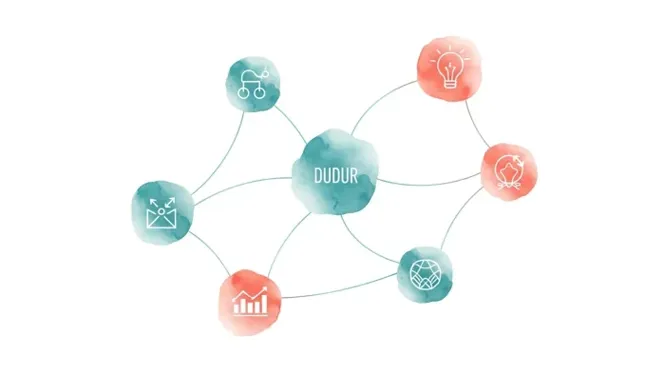
A quick introduction to the ideas, concepts and models that form the basis of the DUDUR method and the articles that build on it.
This page serves as a reference point where you can refresh the key concepts – from the want-to reflex and the four frictions to the SAFL model and Safety-II thinking.
The articles in the series can be read in any order.
When you come across a concept, you can jump here for a brief explanation – or back to the article where it is put into practice.
The want-to reflex
People mean well. They want to do the right thing – if the conditions are there.
But they must dare to act, be able to see the point, be able to do it and experience that it is worthwhile.
When one of the four is missing, friction occurs.
(Read more: “The want-to reflex – why people actually want to do the right thing.”)
The four frictions
Friction | Typical experience | Theoretical basis | Design levers |
Safety friction | “I don’t dare.” | Amy Edmondson (psychological safety) | Acknowledge mistakes, show that action is legitimate. |
Meaning friction | “I don’t see why.” | Self-Determination Theory (Deci & Ryan) | Make the purpose personal and specific. |
Ability friction | “I can’t right now / don’t know how.” | B.J. Fogg, John Seely Brown | Remove hassle, provide cues, learning in the flow. |
Effort friction | “It's not worth the effort.” | Kahneman & Tversky, Ariely | Make the gain clear, cut time and steps. |
(Read more: “The want-to reflex – the four frictions.”)
The knowledge-behavior illusion
(Also called the “If-they-only-knew” reflex )
The belief that information → knowledge → learning → behavior.
In reality, we can know without doing – and do without knowing.
Behavior is not created by knowledge, but by meaning, context, and frictionless action.
(Read more: “Behavioral Design 1 – The Longest Path to Behavior.”)
The top-down reflex
The idea that change can be designed from the top and trickle down through the organization.
It is closely related to the Knowledge-Behavior Illusion – the assumption that more communication or knowledge automatically creates new behavior.
In practice, change happens from below: when we understand the frictions in everyday life and remove them together with those who must act.
(Read more: “The top-down reflex.”)
Safety-II and Work-As-Done
Safety-II sees people as a resource and focuses on why things go well, instead of just avoiding mistakes (Safety-I).
The difference between Work-As-Imagined (how the work is described) and Work-As-Done (how it is actually performed) is the core of Safety-II – and the basis for agency.
We must design for reality, not for the manual.
(Read more: “Safety-II and Work-As-Done.” / “Agency – freedom to be professional.”)
System 1 and System 2
System 1 acts quickly, emotionally, and intuitively.
System 2 thinks slowly and rationally.
Engagement occurs when we first engage System 1 – through ease, meaning and relevance – before System 2 is allowed to understand.
(Read more: “System 1 and System 2 – Why people click next-next-next.”)
The GUIDE method (DUDUR in Danish)
A development model for behavioural design that starts with action – not learning.
- Goal: define the behaviour
- Understand the frictions
- Ideate the solution
- Develop it
- Execute and measure behaviour
GUIDE is based on the AFL principle:
Behavior → Friction → Solution.
The GUIDE method: from idea to behaviour in five steps
- Goalthe behaviourWhat should people do afterwards?
- UnderstandrealityWhat stands in the way today?
- Ideatethe solutionWhat removes the friction? It may not be a course.
- Developwhat is neededShort, concrete and made for the situation.
- Executeand measureDoes the behaviour happen after day 1?
Learning is a means. The goal is behaviour. GUIDE is the English name for the Danish DUDUR method.
(Read more: “The DUDUR method” )
The AFL and SAFL model
A simple three-step diagnostic tool:
Behavior – what should happen?
Friction – what's standing in the way?
Solution – what can remove it?
Used both on the problem and on the solution itself.
I often add an S in front because all behavior happens in a situation.
The SAFL model makes it easier to find the behavior because the context is included:
Situation → Behavior → Friction → Solution.
(Read more: “The DUDUR method” )
Motivation as a field of friction
Motivation is not pressure, but the absence of meaning friction.
It arises when safety, meaning and opportunity are present – and disappears when we try to control it.
(Read more: “We have misunderstood motivation.”)
Self-determination theory
Humans are driven by three psychological needs: self-determination, competence, and belonging.
When they are met, intrinsic motivation grows – when they are blocked, it falls.
(Read more: Self-Determination Theory and Learning )
How it fits together
The concepts are used across the articles – therefore this page functions as a glossary, not as theory.
Use it when you want to rediscover a concept or see how the models are related.
Did you like what you read?
If you think this made sense, you'll probably also want to follow my next project:
I am currently writing volume 2 in the series Superlearning? – the book From Learning Theater to Behavior.
It is about how we can use the DUDUR method to design learning and communication that actually changes behavior.
The book builds on The DNA of Learning – where I show how learning happens in the brain and how we can remove the bottlenecks that stand in the way of understanding, engagement and memory.
Volume 2, From Learning Theatre to Behavior, is about this. It is not finished yet, but the theory behind it is on frictiontheory.org in English, the first chapter is there in Danish, and if you sign up below you will hear when it is.
You can also read more about the series at superlaering.dk